New AI Watermark measures – SynthID and the old Meta Data. How does this impact your business?

Many professionals have been set back in the industry this year, most noticeably in white-collar jobs. But it seems it may all be coming back with a series of new tech breakthroughs in watermarking assets created through AI.
AI has been adding watermarks via metadata in images, and there is a new type of watermarking called SynthID. This ID is extremely hard to erase, and it definitely makes using AI without getting caught that much harder to do. We have tested the outputs and found that audio and images are very well done. In our own testing, filters and smudging have not erased it yet. We expect that some will be able to remove it, but it will be an arms race that I think ultimately will squash AI usage in these areas as final products.
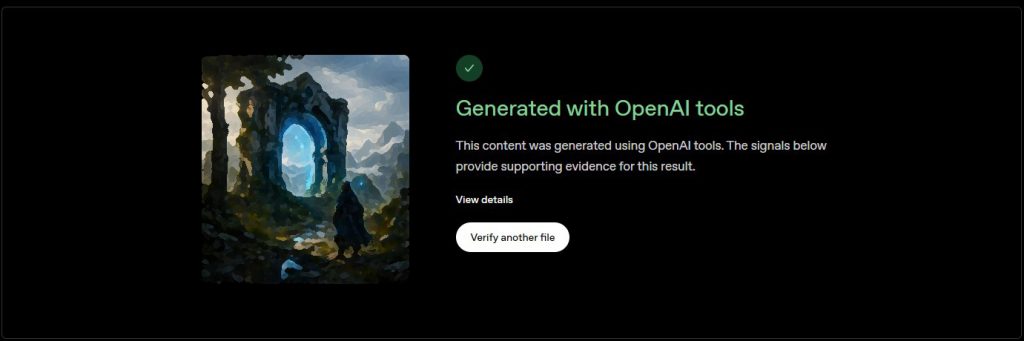
Chrome and many other apps will soon be able to identify AI imagery and audio. How they will present their flags is unknown, but I presume a small grey block on the bottom of anything generated with AI, perhaps even a warning when visiting a site if it is heavily AI-made.
Text hasn’t been updated in the same way, but text was already pretty obvious to detect before these measures were added. I expect the future of text will include similar watermarking technology as well. Strangely enough, much of this tech has already been around in Gemini for a couple of years.
What does this mean for your business?
It means you need to stop using it as a final product and start using AI chats as tools instead. Use images to create drafts and prototypes. Write your own material and use chat minimally; have it check for spelling and punctuation. Keep your own words and thoughts.
If you value your business and what search and marketing mean to it, trust your gut and use your brain to make judgement calls and always examine outcomes. We have already seen significant pivots away from AI-heavy content, where pages that used to rank well have completely vanished and are now unable to rank on Google.
Google doesn’t tell us exactly what is responsible for each individual ranking change, but the level of ranking shifts we’ve seen across millions of sites worldwide since the May Google Update is jaw-dropping. I think everyone learned a lesson here.
Why The Pushing Back Against AI Content
I want to detail a list of all the reasons this is coming down on AI and will most likely be a huge change in what we have all been getting used to while using AI daily.
New EU laws mandating it.
New EU regulations are requiring greater transparency and detection of certain AI-generated content.
AI slop overflooding platforms like YouTube, Steam, etc.
The result is higher server space requirements and higher costs, including payouts from their ad revenue. YouTube has recently cracked down on mass-produced, repetitive and inauthentic content in its monetization policies, hopefully cutting down on low-effort AI channels.
Copyright issues.
Many are hidden, but there are some violations here. Some content was taken without people’s knowledge, and there are questions surrounding whether proper privacy policies and permissions were in place.
Pressure from advertisers on big platforms.
I believe new disclosures will almost certainly eventually include options such as checkboxes for “don’t show my ad near AI content.”
Platform degradation.
For example, searching for a solution but finding a flood of AI versions. Google is increasingly targeting low-quality, scaled and unoriginal content rather than simply AI content itself. In fact, it has become so widespread that many clients who actively used a lot of AI have lost their rankings and will be required to earn trust and rework their content again to reindex. This is something we have been seeing ourselves and doesn’t necessarily mean AI usage alone was the cause.
Misinformation and impersonation are real issues.
Now we can scan videos, audio and other content for detectable signs of AI publicly and potentially build that functionality right into Chrome and other browsers. I expect we will see social networks and a widespread number of platforms adopt measures to flag and potentially omit or restrict certain AI content from their platforms.
Consumer backlash.
I personally love and hate it. I use it as a tool. It is great to ask questions and solve problems and brainstorm ideas. I recently had it tell me what this massive bug was on my car, only to realize it was a cicada, a harmless bug that buzzes in the forests. I won’t lie, I would to see it all burn to the ground, but it is here to stay, but I think it will become what it was always meant to be a tool, not a tool to produce final products and avoid hiring professionals.

The End of AI?
It’s definitely not the end of it, but this certainly paints the way humanity has reacted to AI and what the future will be. We are seeing changes and pivots that will spell out major adjustments to our economy. We are going to see more and more people opt in and out of AI contributions, and so on. Much of these policies are already in place. For example Twitch recently added in AI learning on channels, while also including a opt in toggle.
Going forward, we will be very cautious with AI usage and only use it as a tool. Things that you can’t detect. Staying in the fast lane was never our playbook.
So keep your business in mind going forward with this information. Do you want to cheat today and get caught tomorrow? I would never take that gamble.
Here’s to the future, hopefully one where AI is just a tool that helps humanity prosper together and build better, instead of stealing our own ideas to shovel slop back at us without thinking.
